
Archives
Walter Barco – “Litopintura”
March 22 - May 3, 2015
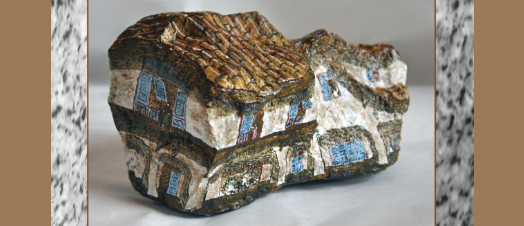
Ecuadoran artist Walter Barco creates extraordinary “rock-works” that evoke nostalgic memories of his native Guayaquil’s colonial architecture and 19th century homes, using a technique he describes as “la litopintura,” or stone-painting. With incredibly fine detail, including tiny figures in the windows of these three-dimensional paintings, he brings 12 of these miniature buildings to the Museum’s Upper Gallery for a unique exhibit from March 22 to May 3.
Working with the natural contours of the stone, Barco recreates the buildings’ walls of mud-and-straw (adobe), which are traditionally painted white, or sometimes structures made of wood and painted in pastel colors of pink, yellow, or blue. They are adorned with wooden balconies, porches, doors and windows.
This mini-village is mounted on revolving turntables so visitors can take in the full dimensionality of these amazing works of art.
The exhibit is supported by a block grant from the State/County Partnership program for the Arts, administered by the Hudson County Division of Cultural and Heritage Affairs.
Kids Map Hoboken Artwork
January 25 - March 15, 2015
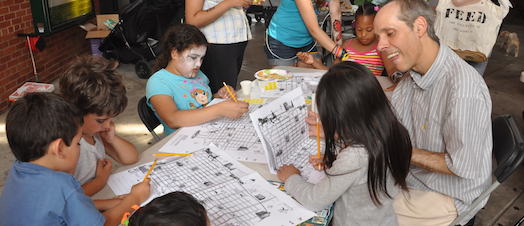
Hoboken is a kid-friendly city — just ask a kid! We asked hundreds of children who visited the Museum with their school groups, scout troops and Family Fun Day participants to list their favorite places in town, and the result is the third edition of our popular “Kids Map Hoboken.” Some of their favorite places are illustrated with original artwork by local children, many of which will be on display in the Upper Gallery of the Museum from January 25 through March 15, 2015.
The new edition of the map was created with the support of a generous grant from the group Party With Purpose, under the direction of the Museum’s education curator, Razel Solow, and designed by graphic artist Claire Lukacs.
The exhibit is supported by a block grant from the State/County Partnership program for the Arts, administered by the Hudson County Division of Cultural and Heritage Affairs.
The Extraordinary Stevens Family, A New Jersey Legacy: 1776-1911
January 25 – July 5, 2015
Click here to take an interactive virtual tour
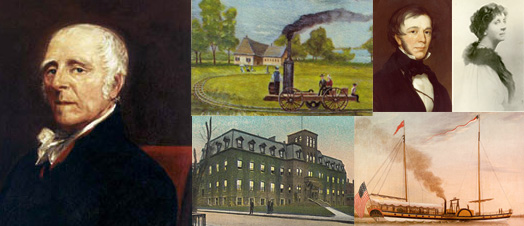
“The Extraordinary Stevens Family, A New Jersey Legacy: 1776-1911” detailed the lives and careers of two generations of the family The New York Times referred to as “one of New Jersey’s first families.” The Stevenses were inventors and designers, engineers and urban planners, and their influence is still very much felt, and seen, in Hoboken, and across the nation.
In addition to planning the city of Hoboken, and building many of the town’s major landmarks (Hoboken Land and Improvement Building, Willow Terraces, and Church of the Holy Innocents), and donating land for important institutions such as City Hall and the Hoboken Free Public Library, Colonel John Stevens III, along with his sons Robert Livingston, Edwin Augustus, and John Cox, made major contributions in the areas of steam transportation, railroads, architecture, and education.
Working with archivists and researchers from Stevens Institute of Technology, the first engineering school in the United States that was founded by Edwin Stevens’ estate, the exhibit featured patent models, military uniforms, maps, photos, 19th century furniture and personal family items from the family estate in Hoboken known as Castle Stevens. The museum also displayed original documents from the Stevens Institute of Technology collection, including correspondence with Alexander Hamilton, Aaron Burr, James Madison, Robert Fulton, Richard Stockton, and many other historic figures. Many of these artifacts have never been seen by the public. The Stevens family were very politically astute and their descendants married into some of the most influential families in the country. The family corresponded with presidents and entertained royalty.
The Stevenses were also slaveholders, and the exhibit lecture series will feature a talk about Peter Lee, a former slave who was with the family from 1804 until his death in 1902, when flags were flown at half-mast at Castle Stevens to honor his passing. He was considered a part of the family and is buried in the Stevens family plot. In addition, the time period for this exhibit (mid-1700s through 1900) provides the Museum with a rare opportunity to explore 18th century life in New Jersey.
While the Stevenses’ legacy can be clearly seen and felt in Hoboken, it is their contributions to New Jersey and the nation that will be the focus of this exhibit. Colonel Stevens and his sons were forward-thinking inventors and their innovative designs were adapted by shipbuilders and railway companies across the country. Robert Livingston Stevens, the Colonel’s middle son, revolutionized how trains were built and operated with his invention of the t-rail and spike, still in use today. Father and son were also interested in using steam to power railroads, and in 1826 the Colonel had a track built on his property in Hoboken so he could experiment with a steam locomotive driven by a multi-tubular boiler that carried passengers around the track at 12 miles an hour. This was the first engine and train that ever ran on a railroad in America.
The land that is now Hoboken had been confiscated by the State of New Jersey from a British loyalist and was won in an auction by Colonel John Stevens III, a revolutionary war hero from Perth Amboy, N.J., for $90,000 in 1784. In order to make Hoboken more appealing to homesteaders, Col. Stevens developed Hoboken as a pastoral getaway for New Yorkers weary of the dirty city. Open meadows, walkways along the river, inns, the “natural spring waters” of Sybil’s Cave, were all designed to entice buyers to purchase plots in the newly laid out community. These plots sold slowly at first, even with the added bonus of advertising Hoboken as being free of “yellow fever,” but after Col. Stevens established the Hoboken Ferry Company, with steam-powered ferries making regular trips between Manhattan and Hoboken, the town began to fill with the area’s first commuters.
The Stevens women were equally progressive-minded contributors to the betterment of society. Martha Bayard Dod Stevens, wife of Edwin Augustus and a descendent of the British loyalist who lost the land that Colonel Stevens won at auction, has contributed as much as any of her in-laws. It is probably Martha Stevens whose influence is most felt in Hoboken. Her interests in education, housing for laborers, and opportunities for working women, drove her to establish a foundling hospital, Holy Innocents Church, the Hoboken Free Public Library (National Register of Historic Places), and an industrial training school for young women and men. In addition, as a result of a trip to the Scottish village of New Lanark, a community founded by utopian social reformer Robert Owen, whose clean, affordable housing for workers inspired Mrs. Stevens to commission similar housing at the Willow Terraces in Hoboken. Widowed at age 37, she was left to carry out her husband’s wishes for a school of higher learning to be built on the family property. It was in honor of her family’s innovative natures that she chose to build a school of engineering.
Lou Carbone – “New Paintings”
November 9 - December 23, 2014
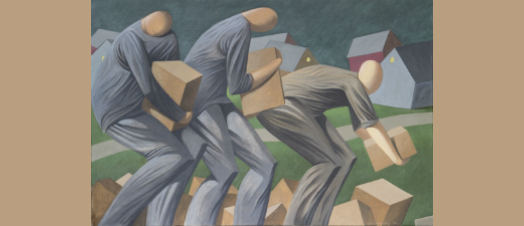
With diverse influences that include cubism, surrealism and the Mexican muralists, Lou’s paintings are a series of pictorial spaces borne of personal experience as filtered through dreams and illusions. The images of anonymous figures in common settings depict ritual happening combined with feelings of sexual tension that are woven with a quiet elegant motion.
Each canvas is a merging of fact and fantasy that opens a window to animated yet mysterious places. Many of the objects and figures are structured, ordered and linear yet they create elements that have references to the mystical and spiritual, using multiple perspective and intense color. Lou has developed an assortment of visual symbols in an effort to pare cultural traditions and rituals to their essence and intensify the relationships between his subjects. His tools may be color, line and composition but the imagery is formed through the visceral process of thought. The show opens on Nov. 9, with a free reception from 2 – 5 p.m., and remains on view through Dec. 23.
To see more examples of Carbone’s work, visit his website, www.loucarbone.com.
The exhibit is supported by a block grant from the State/County Partnership program for the Arts, administered by the Hudson County Division of Cultural and Heritage Affairs.
Ibou Ndoye – “Art for Life”
September 21 - November 2, 2014
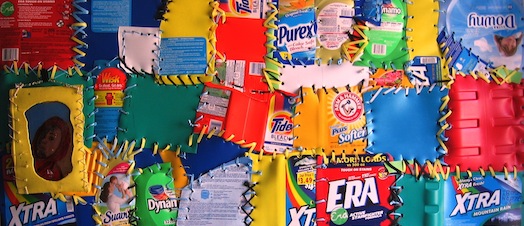
Ibrahima Ndoye, who goes by “Ibou,” has been an artist all his life. Born in Senegal to a family who expressed their creativity in tie-dying, embroidery, welding and dressmaking, Ndoye learned from an early age that nearly any material can lend itself to creative hands.
“When I was a boy, my mother would tease me, saying that if I didn’t create something, my hands were blind,” he says. He grew up surrounded by textiles in rich colors and bold patterns, in a culture that was very creative – Dakar, he says, is one of West Africa’s most progressive cities. So it only seemed natural that Ndoye was drawn to art as a vocation, beginning his career as a painter in the late 1980s while still living in Senegal. He was influenced by a popular movement that encouraged artists to embellish the urban environment by painting murals on buildings and walls – he painted several in the suburban city of Pikine that were featured in a French documentary in 1990.
He then learned the technique of glass painting, a Middle Eastern tradition that had been introduced to Senegal a hundred years earlier. Adding an innovation of his own, Ndoye began using broken pieces of glass, some of it repurposed from old windows and other discarded glass. He feels it conveys another layer of meaning, about the broken communications and broken relationships that people persevere to overcome.
“The more you talk with people the more you know who they are,” he adds. He views art as a vital way of communicating. When he moved to the United States in 2001, he was initially drawn to Hudson County because he had friends here, but stayed because of the vibrant arts community. He joined several artist organizations, and helped Liz Cohen and other Hoboken artists to found the hob’art artists gallery group. Through these contacts, his work has been exhibited in numerous group and solo shows in and around Hudson County. He also has taught several art workshops, in the homeless shelter and at the Hoboken Library. “People really value art here – it’s like a cultural exchange,” he observes.
Lately, he’s been fascinated with the question of recycling and laundromats, inspired in part by the post-Sandy clean-up. “Everyday objects have an importance for me,” he says. “And finding new uses for everyday objects is not just a way to help our ecosystem; it also makes the city beautiful and clean again.”
Several of the works that he will exhibit in his new show, “Mixed Media Artworks and Glass Paintings by Ibou Ndoye,” in the Museum’s Upper Gallery will be brightly colored creations made of cut and assembled pieces of detergent bottles and other laundry paraphernalia. In addition, he will show several glass paintings on salvaged windows he has collected around Hoboken from home remodeling projects. He enjoys giving a second function and new artistic life to windows, which have always been a part of his art. The show opens on Sept. 21, with a free reception from 2 – 5 p.m., and remains on view through Nov. 2.
To see more examples of Ndoye’s work, visit his website, www.iboundoye.com.
Click here to see a virtual gallery of the exhibit.
The exhibit is supported by a block grant from the State/County Partnership program for the Arts, administered by the Hudson County Division of Cultural and Heritage Affairs.
Hoboken, Ellis Island, and the Immigrant Experience, 1892-1924
August 3, 2014 – December 23, 2014
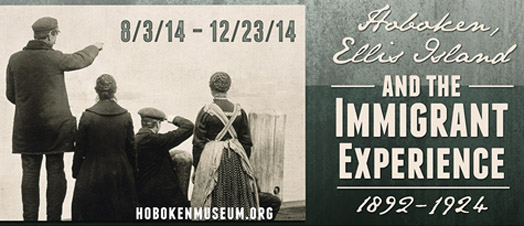
Click here to take an interactive virtual tour of the exhibit.
If Hoboken seems crowded today, with a population just over 50,000, imagine how crowded it was between 1892 – 1924, the peak period of U.S. immigration. Following the Immigration Act of 1891, which established federal control over immigration, Hoboken’s—and the entire country’s—demographics changed dramatically. During the next three decades, 20 million people immigrated to the United States, and more than half, 12 million, passed through the New York and Hoboken.
Hoboken became renowned across the world as “the port of entry to a continent,” according to Daniel Van Winkle’s history of Hudson County, published in 1924. Hoboken’s population swelled from 43,648 in 1890 to 70,324 in 1910 with the surge in European immigration, which was fueled in part by the major passenger shipping lines that docked here, including Hamburg-America Packet Company, North German Lloyd Steamship Company, Scandinavian-American Line, and Holland America Line.
The Hoboken Historical Museum examined this period in a new exhibit, “Hoboken, Ellis Island, and the Immigrant Experience, 1892-1924,” which opened Sunday, Aug. 3. Guest curator Dr. Christina Ziegler-McPherson, an immigration historian who lives in Hoboken, brought to life through images, artifacts, and oral histories the experience of immigrants who passed through Ellis Island and Hoboken during the peak years of U.S. immigration. A companion lecture series, “The Immigrant Experience,” brought noted scholars and authors to the Museum to expand on the topic.
Immigration Transformed Hoboken
In addition to descendants of Dutch and English settlers, German and Irish immigrants had largely shaped Hoboken in the mid- to late 19th century. In 1890, 40 percent of Hoboken’s population of 43,648 was foreign-born—and the majority of the city’s native-born residents had parents born in Germany or Ireland. Only 790 Italian immigrants lived in Hoboken in 1890.
Just two decades later, in 1910, Germans and German-Americans continued to dominate Hoboken, but for the first time, the city had more Italian and Italian-American residents than Irish and Irish-Americans. Hoboken also had a growing number of residents born in Russia, Austria, and Norway.
The exhibition also offered an in-depth look at the conditions immigrants faced before leaving their ports of embarkation, and the class divides on board between first and second class and steerage. The treatment received on arrival in New York Harbor differed by passenger class, too, with the steerage passengers diverted to Ellis Island for screening, while first and second class passengers simply disembarked in Hoboken or New York after an on-board health check, and then were free to go. The exhibit ran through December 23.

Tracie Fracasso – “Artworks”
August 3 - September 14, 2014
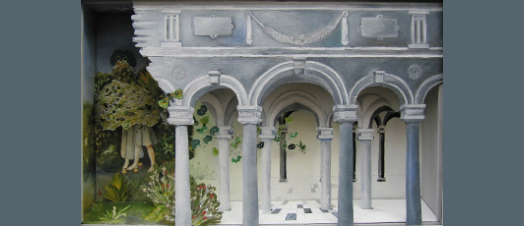
In an age of digital media, Tracie Fracasso’s artworks demand to be seen in person – a flat screen cannot do them justice. Her works are multilayered, two-dimensional images carefully arranged in a three-dimensional space within a glass-fronted frame. She calls it, half-joking, “two-and-a-half D art,” or “3D collage.”
Neither term quite describes her unique artworks, which are similar to the box assemblages of Joseph Cornell and Betye Saar, except that Fracasso’s boxes incorporate drawings, oil paint and prints on cut paper as opposed to found objects. A selection of her recent creations, “Artworks by Tracie Fracasso,” went on display Aug. 3 – Sept. 14, 2014 in the Hoboken Historical Museum’s Upper Gallery.
Fracasso’s approach to creating her layered compositions traces its origins to her college days. In pursuing a BFA in Studio Art at Rutgers University and an MFA in Fine Arts at Montclair State University, she studied both painting and sculpture, and she continues to combine both in her work. A college course in photomontage inspired her interest in layered juxtapositions of images, while her love of Renaissance and church art led her to develop her painting skills under the tutelage of a professor she admired at Montclair.
Each piece can take months to complete, from working out the concept, to gathering material and research, to the execution stage, when Fracasso meticulously works and reworks the composition until she’s satisfied with the relationship among the separate elements. That’s what she finds so engrossing about her chosen medium: the dynamic tension between the elements, both spatially and stylistically, as well as the tension between her contemporary themes and classical references.
“In a formal sense, my work is about the deconstruction of the illusion of space and linear perspective,” Fracasso says. “I think if I had to stick to just painting, I’d get bored.” Like Cézanne and other modern artists, she enjoys breaking the conventional rules of linear perspective, playing with the tension between creating or denying the illusion of space.
Conceptually, her work raises questions about contemporary issues, but viewed within a historical perspective. In the work “Slaying of Isaac” (2008), she draws a connection between a modern tragedy, the shooting of the three students in Newark, and the iconic Old Testament story. In the work “Naïve: Mother I Am not Eve” (2012), which depicts a classically painted female figure strolling through a Renaissance-style garden, but surrounded by contemporary children fighting and pitching tantrums – evoking modern feminist issues. “Temptations” was inspired by the news of the Arab Spring uprisings, and shows an oil refinery in the background, while in the foreground, a man in blue jeans juggles the planets in a park-like setting next to a Christ figure.
Other works, such as the fancifully named “Long Neck on the Garden State Parkway Coming Back from LaDu’s” (2011), are inspired by her own experience, sights that are familiar to this Jersey City-born, Bayonne-raised Hoboken resident, who has spent many hours on the Garden State Parkway. Fracasso moved to Hoboken 20 years ago, where she lives and maintains an art studio. She loves Hoboken for its sense of community, where a stroll down Washington Street to enjoy its restaurants or bars always involves running into someone you know. When she’s not making art, she teaches art as an adjunct professor at Kean University. Learn more about her work at traciefracasso.com.
The exhibit was supported by a block grant from the State/County Partnership program for the Arts, administered by the Hudson County Division of Cultural and Heritage Affairs.
Click here to see a virtual gallery of the exhibit.
Adam Rodriguez – “Clubhouse Requiem”
July 14 - August 18, 2013
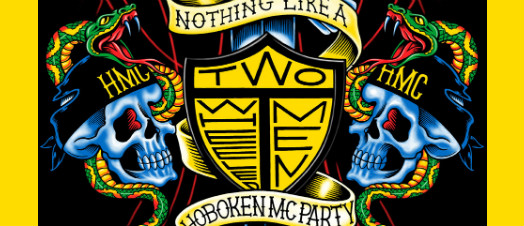
You’ve probably seen Adam Rodriguez’s art, without knowing it. As a professional artist with the New York-based graphic design firm Success Apparel, he’s created designs for some of the most recognizable brands in the world, including John Deere Apparel, Dickies and Yo Gabba Gabba.
In his own freelance business, Adam is also the artist behind the iconic t-shirt designs sported by the Hoboken Motorcycle Club, whose members also sell them at city festivals. The t-shirts commemorate the group’s legendary parties. If you’ve been privileged to attend an HMC party at the clubhouse, located just south of Hoboken, he painted three of the interior walls with bright orange flames in a muscular style (also seen on the cover of hMAG last year in a feature on the HMC).
“I hope to finish the fourth wall someday,” Adam says, “but it’s behind the bar, which is pretty well-stocked. It would take a lot of work to clear that area for painting.”
A selection of his HMC t-shirt designs were on display July 14 – August 18, 2013 in the Upper Gallery at the Museum, around the centerpiece of the exhibit: “Clubhouse Requiem,” a large group portrait depicting about 40 HMC members—past and present.
“Clubhouse Requiem” is a modern take on Rembrandt’s “Night Watch,” which was commissioned in 1642 by a private Dutch militia to commemorate its band of brothers, full of symbols important to the members of the militia. Though Adam is quick to point out he’s not comparing his work with the Dutch master’s, the motivation for the mural is similar – to portray the collective and individual spirit of a close-knit group of men united by a mission.
The mural, roughly 20” x 30” wide, shows all the current members of the HMC standing in front of their respective bikes, with a representation of the club and notable landmarks of the Hoboken skyline in the background. Stylistically, Adam cites the painter Joe Coleman as his inspiration for the level of detail and vividness of his work.
He describes the project as an endeavor to “memorialize the current, and some past members, of the Hoboken Motorcycle Club.” He adds, “By virtue of their fierce individualism, motorcycle clubs are similar to the Northern European Crusaders of the Medieval period, having traded horses for motorcycles, mead for Michelob, and Renaissance fairs for Road Rallies.”
Adam is not a member of the club, but he admires the members’ rebel spirit and blue-collar roots. He’s a Northern New Jersey native, who visited Hoboken frequently as a boy. His father was also an artist, and ran a graphic design studio that did a lot of work for Madison Avenue advertising agencies. Adam worked there for a while, after earning a degree in illustration from the Rhode Island School of Design and taking academic courses at Brown University. He didn’t care for some aspects of the agency business, so he spent about a decade as a union carpenter and a teamster, working at heights on skyscrapers, and underground on the Lincoln and Holland Tunnel. Though he works in New York City, Rodriguez lives in Stroudsburg, PA, with his wife and five children.
This exhibition was made possible by a Block Grant from the State/County Partnership program for the Arts administered by the Hudson County Division of Cultural and Heritage Affairs/Tourism Development, Thomas A. DeGise, County Executive, and the Board of Chosen Freeholders.
Jennifer Place & Jodie Fink – “Local Motion”
May 18, 2014 - July 6, 2014
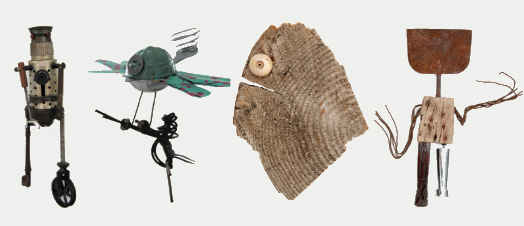
Bowerbirds don’t merely “feather their nests” — they create elaborate art installations to impress prospective mates, using colorful materials collected from around their environment, such as cast-off bottle caps, buttons and trinkets. Jennifer Place identifies with the impulse to collect. The artist and her friend Jodie Fink have been making sculptures from detritus that attracts their eye from their walks around Hoboken for many years. They had a joint show, “Friends and Relations,” at the Museum three years ago.
Lately, Place has been thinking a lot about the bowerbirds, since she’s had to re-feather her own nest after superstorm Sandy swept through her lower Madison Street home and washed out many of her collected supplies—mostly the larger pieces—that were stored in her garden shed. Consequently, she’s working in a smaller format these days—with lots of rusty bits of hardware and small items picked up in the environment.
Superstorm Sandy also wiped out a lot of Fink’s supplies, inundating her basement storage space with five feet of water. She now looks at the storm philosophically, learning the truth of the saying that, sometimes, “less is more.” Her work is increasingly minimalist; one piece is simply an expressive piece of driftwood with a fishing bobber affixed for an eye, making it into a fish named “Henry.” The other trend in her recent work is incorporating an element of motion, with pieces that hang or parts that move.
The two artists are teaming up again for a show they’re calling “Local Motion: Mixed Media Sculptures by Jennifer Place and Jodie Fink.” The exhibit opens in the Museum’s Upper Gallery on Sunday, May 18, with a free reception from 2 – 5 p.m., and remains on view through July 6. Each artist is exhibiting about a dozen works.
Both artists started out working in other media: Fink studied photography in college and Place is a professional graphic artist who started out in drawing and printmaking and now works primarily in jewelry and sculpture, including working with hot glass beads. Fink is now gravitating toward painting and drawing, part of her trend toward simplifying.
The two artists both say that the changes in the city’s demographics have changed the materials they use in their work. When they arrived in the early 1980s, Hoboken was an ethnically diverse town, with lots of local characters, gritty bars, pop-up art galleries and a dynamic music scene. Back in those days, they say, scrounging for “art stuff” was a constant thrill, and artists would call each other on moving days when a particularly rich pile of stuff appeared on the curb. Now, the cast-offs are likely to be less interesting, Ikea furniture and the like. However, the constant construction projects and greater access to the waterfront are supplying more interesting bits and pieces.
Half the fun of seeing a Fink-Place art installation is trying to figure out the origins of the individual parts. One of Fink’s pieces, “Ballerina,” is composed of an element from a gas stove, a pushmower handle, and a lamp bracket. Both artists have exhibited extensively at galleries around the region.
The exhibit is supported by a block grant from the State/County Partnership program for the Arts, administered by the Hudson County Division of Cultural and Heritage Affairs.
Click here to see a virtual gallery of the exhibit.
Tim Daly – “Important Clouds”
March 23, 2014 - May 11, 2014
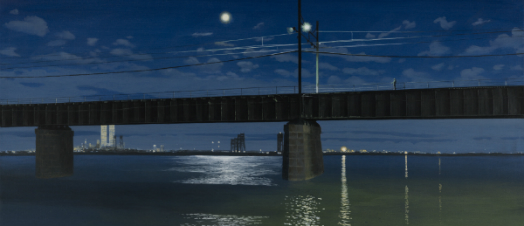
Most of us deliberately tune out the scenery along New Jersey highways as we drive past the railroad and highway bridges crisscrossing the Meadowlands marshes. It’s hard to categorize what we’re seeing—neither planned architectural landscaping nor unfettered nature, it’s a hybrid environment that evolved haphazardly. But these overlooked scenes take on entirely new significance when interpreted by the skilled hands of Hoboken artist Tim Daly.
Many of his landscapes are dominated by luminous skies filled with cumulus clouds, or skies that are empty but for streaky jet contrails floating over utility towers or highway overpasses. Or lonely night skies eerily lit by highway light fixtures. Daly’s pastels and paintings capture these scenes at those moments during the day or night when the light is at its most beautiful and mysterious, so that it almost doesn’t matter what is in the scene. Except that it does—these stretches are as much a part of our physical environment as the intentionally designed ones. Daly’s pastels and paintings help us appreciate them with new eyes.
“I’ve been told several times over the years that I create, in my believable realist landscapes, a psychological space as well,” he says. “It’s ephemeral, darkness visible, at times. I was drawn then as now to lights in the dark and to telling details. I’m a sucker for Ailanthus trees and the spectacles of bright and dark skies over wild industrial and urban landscapes.”
As a Jersey City native, who explored the Meadowlands as a boy, he began sketching that landscape during the eight years he worked at two Postal Service facilities located in the heart of the marshy no-man’s-land. He considers it his graduate school, after studying at New York’s School of Visual Arts from 1971 – 73, when video and photography were all the rage and the Dutch and English realist landscape schools of painting he so admired had fallen out of fashion. He honed his skills there, drawing and painting scenes from sea level and from the top of Snake Hill, the stone outcropping by the NJ Turnpike’s Eastern Spur.
Daly’s latest series of landscapes rendered in pastels with nearly photographic detail, plus giclée prints from earlier paintings, were on display in the Upper Gallery of the Hoboken Museum. Titled “Important Clouds: Pastels and Giclées by Tim Daly,” the exhibit opened on March 23, 2014 with a free reception from 2 – 5 pm, and remained on view through May 11.
Click here to see a virtual gallery of the exhibit.
In addition to his lifelong fascination with the Meadowlands, Daly has been working on scenes from around Los Angeles—not the glamorous California seen on TV and movie screens. His California scenes are of surfers at Venice beach, or stretches of highway with brush fires in the distant hills. Some of the recent works were inspired by scenes from Long Island City, where he works as a scenic artist, a proud member of the United Scenic Artists Local 829. He’s painted sets for such shows as HBO’s “The Sopranos,” “Girls,” and “Boardwalk Empire,” among others. See more examples of his work at timdaly.artspan.com.
Daly moved to Hoboken in 1977, when it was a different world: Maxwell’s was a funky bar, the Washington St. bus cost $.25, and rents were low enough for an artist to afford, he says. “I met my lovely wife, Sheilah Scully, and was drawn with her into Hoboken’s progressive political campaigns, including Mayor Tom Vezzetti’s victory, and a four-year long condo conversion battle.” He advises anyone interested in that period to seek out Nora Jacobsen’s documentary film, “Delivered Vacant,” in which he and Sheilah make cameo appearances.
The exhibit is supported by a block grant from the State/County Partnership program for the Arts, administered by the Hudson County Division of Cultural and Heritage Affairs.